By Dr. Boiselle, Au.D., CCC-SLP
Lead clinician · AuDSLP, Elmwood Park NJ
If you are wondering whether your child needs a hearing test, this guide will give you a clear answer. You will learn the specific signs that warrant an evaluation, what a pediatric appointment actually looks like, and when a hearing test is enough versus when the next step is an auditory processing evaluation.
AuDSLP sees children ages 5 through the teenage years for hearing care, auditory processing testing, and speech-language services in Elmwood Park, NJ. Bergen and Passaic County families come to us when a parent, teacher, or pediatrician says the words “let’s get her hearing checked.”
01
Signs your child needs a hearing evaluation
Most parents notice the pattern before they have the words for it. Watch for these specific behaviors in school-age kids:
- Frequent “what?” — your child asks you to repeat yourself several times per day, especially when you are not looking right at them.
- TV or tablet volume creeping up. Adults in the room start asking your child to turn it down.
- Struggles to follow directions with more than one step, particularly in a noisy room or busy classroom.
- Tunes out in group conversation. One-on-one with you is fine. A birthday party or a noisy cafeteria is a different story.
- Teacher flags attention concerns, reading difficulty, or trouble with spelling — but you sense it is more than attention.
- A history of frequent ear infections, ear tubes, or speech-language delay.
- Your gut says something is off. Parents are the most reliable early-warning system in pediatric audiology.
02
Hearing vs. listening — what is actually happening
There is a difference between a child who cannot hear sound and a child who hears sound clearly but cannot make sense of it. Both look like “my kid doesn’t pay attention.” Only one of them is solved by a standard hearing test.
A standard pediatric hearing test answers the first question: does the ear pick up sound across the speech frequencies at normal volume? If the audiogram is normal but you are still seeing the signs above, the next step is an auditory processing evaluation. Processing is a brain-level skill, not an ear-level one. We test it separately.
03
What a pediatric hearing evaluation actually looks like
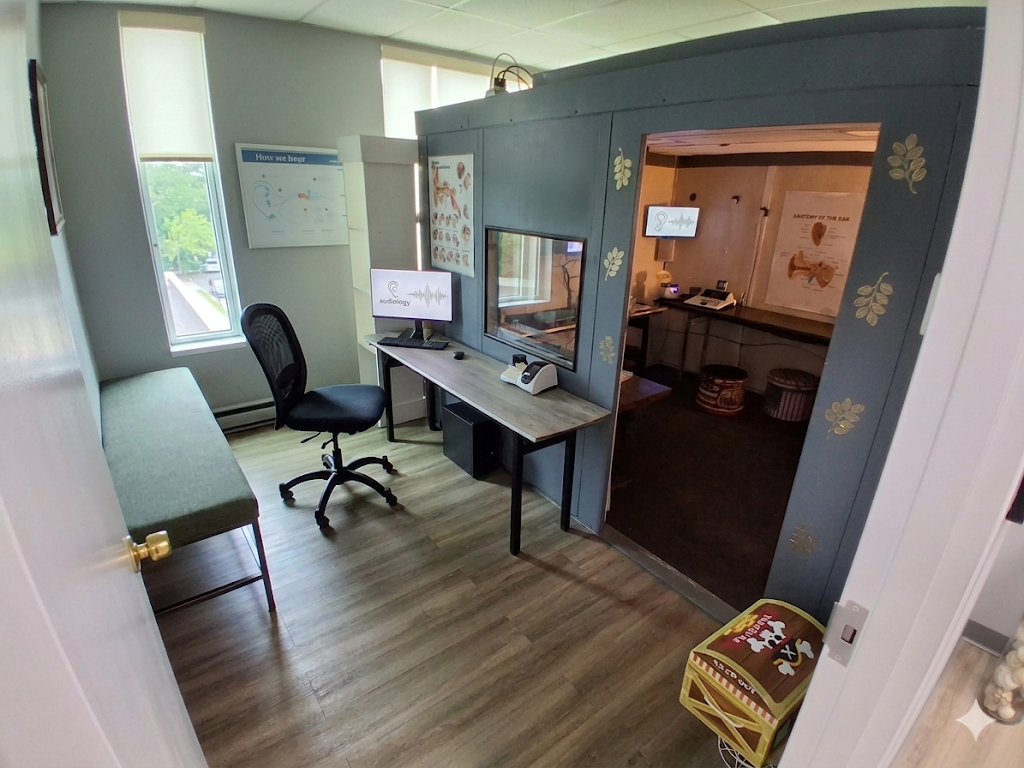
The visit takes about an hour. There are no needles, no sedation, and nothing scary. Here is the exact sequence at AuDSLP:
- Case history (10–15 minutes). You and Dr. Boiselle talk through your child’s health history, school performance, and what specifically prompted the visit.
- Otoscopy. A look in each ear to rule out wax, fluid, or anything that would skew results.
- Tympanometry. A 30-second test that measures middle ear movement — important for kids with a history of ear infections.
- Pure-tone audiometry. Your child wears headphones and responds to soft tones. Younger kids get play audiometry — drop a peg in a bucket each time they hear a sound. Older kids press a button.
- Speech testing. Repeat back words at conversational and soft volumes. We also do speech-in-noise testing when the case history suggests classroom struggle.
- Results conversation. Plain-language results, specific recommendations, and a written summary you can share with your pediatrician and your child’s school.
04
When a hearing test isn’t the whole answer
Some kids leave a hearing test with a normal audiogram and a parent who still knows something is wrong. That is the moment to look at auditory processing.
Auditory Processing Disorder (APD) is what happens when the ear picks up sound normally but the brain has trouble sorting, sequencing, and making sense of it. Kids with APD often pass school hearing screenings, then struggle in noisy classrooms, with multi-step directions, or with reading and spelling. AuDSLP offers a complete APD evaluation covering dichotic listening, temporal processing, auditory patterning, and binaural integration — the four areas a standard hearing test does not assess.
05
How to know it’s time to book
Use this simple rule: if you have noticed two or more of the signs above for more than a few weeks, book the evaluation. The worst case is that everything is normal and you have peace of mind. The best case is that you catch something early enough to actually do something about it.
A pediatric hearing test at AuDSLP is the right starting point for kids ages 5 and up. If the audiogram is normal and the real-world struggle continues, we move to auditory processing evaluation as the next step. See the full list of pediatric services for what we offer in one visit.
Schedule by phone at (201) 773-8962 or use the contact form. We see Bergen and Passaic County families Monday through Friday.